Even water that appears clean contains particulates - suspended solids, sediment, scale particles, biological material, and dissolved impurities that are invisible to the naked eye but cause real and progressive damage to building water systems and the equipment connected to them. Filtration is the process of removing these contaminants before they reach sensitive plant, create biological risk, or compromise the quality of the water supply.
Hydrotec provides filtration solutions across the full range of building water applications - from simple strainers protecting individual items of plant through to multi-stage systems producing high-purity water for demanding process and equipment applications. We work with M&E consultants, contractors, facilities managers, and site operators across the world.

Where do particulates come from - and why does it matter?
It is a common assumption that mains water arriving at a building is clean. In practice, even treated mains water carries suspended particles - pipework corrosion products, scale debris, sediment mobilised during pressure fluctuations, and residual material from the distribution network. In the UAE and Gulf region, desalinated or borehole water supplies introduce their own distinct challenges, including residual sediment, elevated dissolved mineral content, and in some cases iron, manganese, and other impurities requiring specific removal.
Within a building's own distribution system, further contamination is generated - corrosion of ageing pipework, scale flaking from surfaces, biofilm material breaking away from pipe walls. By the time water reaches sensitive equipment, it may carry a significant particulate load even if it started out clean at the point of entry.
The consequences of unfiltered water are significant and cumulative.
Particulates in water systems cause damage that accumulates quietly over time, often remaining invisible until a component fails or a system underperforms. Suspended solids settle in storage tanks and calorifiers, creating the conditions for bacterial growth - including Legionella. They damage the internals of high-efficiency water heaters, plate heat exchangers, and pressure-reducing valves. They reduce the effectiveness of UV disinfection systems by absorbing UV energy before it reaches bacteria. They clog the resin beds of water softeners and the membranes of RO systems, reducing performance and shortening service life. And they accelerate corrosion of metallic pipework by acting as an abrasive and by creating differential aeration cells that drive localised pitting.
Filtration is also a prerequisite for many downstream treatment processes to function correctly. A UV system installed without adequate pre-filtration will underperform from the outset. An RO membrane exposed to unfiltered feed water will foul rapidly and fail prematurely. Getting the filtration stage right is not a secondary consideration - it is foundational to the performance of the entire treatment train.
Our Solutions
Particulate Removal and Point of Entry Filtration
The first line of defence in any water system - removing suspended solids, sediment, and debris from the incoming supply or from within the distribution network. Strainers and filters are available in a range of micron ratings to suit the application, from coarse protection of pipework and valves through to fine filtration ahead of sensitive plant. Cost-effective and straightforward to install and maintain.
Side Stream Filtration
The first line of defence in any water system - removing suspended solids, sediment, and debris from the incoming supply or from within the distribution network. Strainers and filters are available in a range of micron ratings to suit the application, from coarse protection of pipework and valves through to fine filtration ahead of sensitive plant. Cost-effective and straightforward to install and maintain.
Selective Impurity Removal
Where the incoming water supply contains specific dissolved impurities - iron, manganese, chlorine, pesticides, or other contaminants - selective media filtration removes the target impurity without affecting the broader water chemistry. This approach is particularly relevant for borehole and groundwater supplies, which often contain elevated levels of iron and manganese, and for supplies in the UAE and Gulf region where water quality characteristics differ significantly from treated mains water in the UK. Systems are designed to the specific feed water analysis of the site.
High Purity and Demineralised Water
Some applications require water that has been stripped of dissolved minerals entirely - producing a consistently high-purity output regardless of the feed water quality. Deionisation, mixed bed resin systems, and reverse osmosis (covered in detail on our RO and Desalination page) all produce water suitable for demanding process applications including boiler feed, commercial catering equipment, industrial air conditioning, and laboratory use. Systems are designed in-house to the specific purity requirement of the application.
Our Products
HydroFIL® & other filters

The vacuum cleaner for water.
See MoreHydroMOS®

Reverse osmosis filtration. When you need your water to be really, really pure.
See MoreHydroFIL® ULTRA
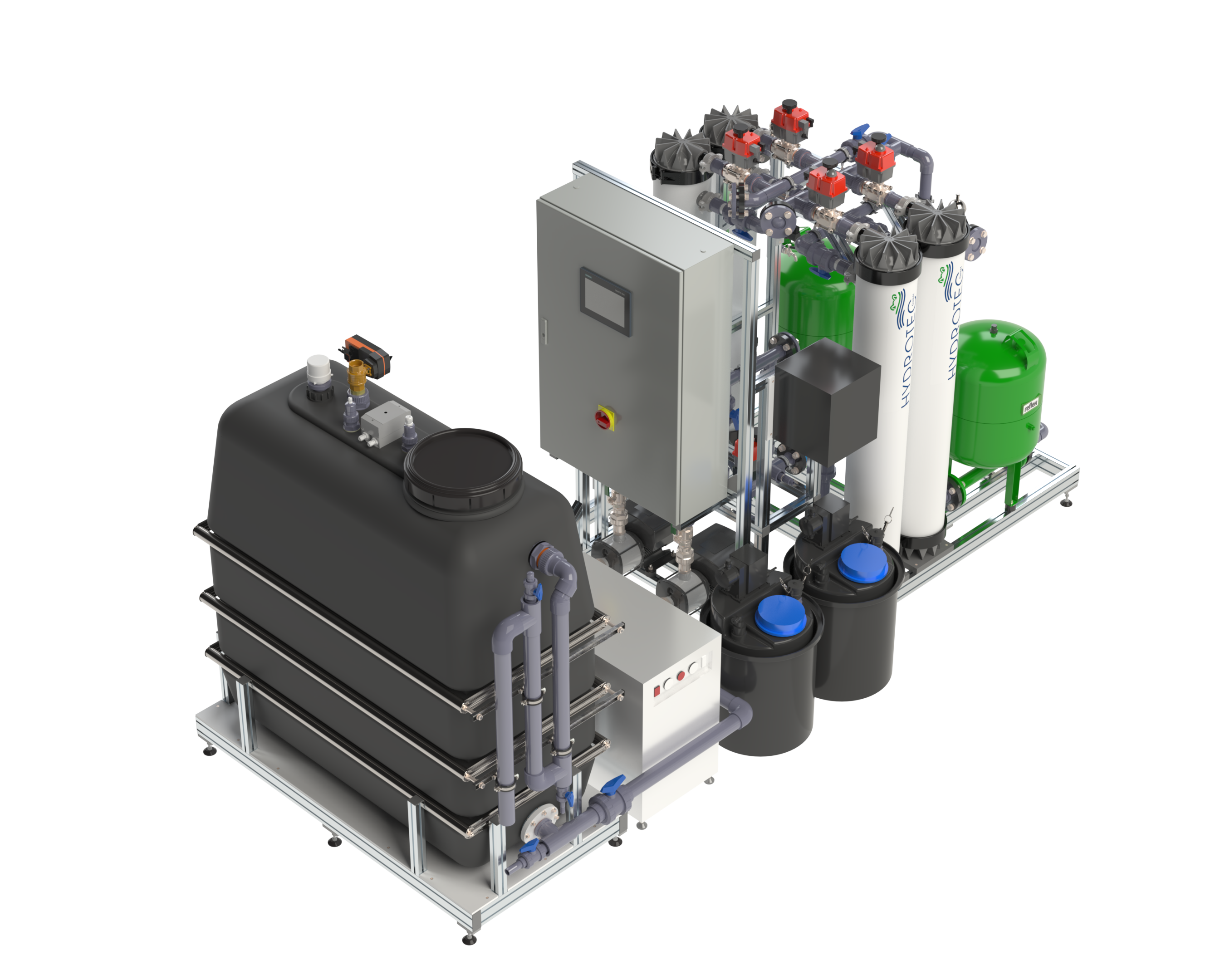
Advanced ultrafiltration systems for high‑risk water systems.
See MoreHydroSOLV®

Selective impurity removal.
See MoreOur Offering
We carry out water analysis before recommending any filtration solution, ensuring the system is designed to address the actual contaminants present in the supply rather than a generic assumption. Where filtration forms part of a broader treatment train - ahead of a UV system, softener, or RO plant - we design it as an integrated stage rather than an afterthought.
- Water analysis and feed quality assessment
- System design matched to the specific contaminant profile and application
- Supply, installation, and commissioning
- Integration with broader treatment trains - UV, softening, RO
- Ongoing maintenance, media replacement, and cartridge programmes